Is an Animation Degree Worth It?
Is an animation degree worth it? Learn the real pros, cons, costs, and best alternatives — so you can decide what's right for your animation career.
Article by Richard Arroyo & iAnimate Team
Last updated: June 2026
An animation degree is not required to get hired at most studios. Employers prioritize a strong demo reel and proven skills over a diploma. Whether it's worth it depends on your career goals, financial situation, and whether you need a degree for a work visa. This post breaks down the pros, cons, costs, and best alternatives.
Is an Animation Degree Worth It? Honest Answer
You've been drawing since you were a kid. You know you want to animate. But now someone's asking you to spend $80,000 on a degree, and you're not sure if it's worth it.
Here's the truth: the animation industry doesn't care much about your diploma. What it cares about is what you can do.
By the end of this, you'll know exactly when a degree makes sense, and when it's a waste of money.
"Richard Arroyo, Ubisoft Director and iAnimate Co-Founder trained hundreds of animators at iAnimate, worked with artists from Pixar, Disney, and DreamWorks. Here's what he have seen firsthand."
The Industry Truth: Skills and Portfolios vs. Degrees
In the animation industry, hiring decisions are based primarily on an artist's demo reel and practical skills, not academic credentials. Studios like Pixar, DreamWorks, and Blizzard Entertainment evaluate applicants through portfolio reviews rather than transcripts. Many working animators hold degrees in unrelated fields or none at all.
Studios don't ask for your diploma at the portfolio review. They ask to see your reel. That's the whole game.
Why your portfolio matters more:
- A strong demo reel shows what you can actually do on day one
- Character animation, 2D/3D work, and visual development speak louder than any credentials
- Successful animators like Pep built careers without traditional degrees
"Ric has reviewed thousands of reels. The ones that get callbacks all share one thing: clear, confident execution, not a school logo."
The Benefits of a Formal Animation Degree
A formal animation degree offers a structured curriculum, access to industry-standard software, and direct mentorship from working professionals. Programs at schools like CalArts and Sheridan College provide students with three to five years of focused immersion in animation craft, storytelling, character design, and storyboarding — often alongside peers who become future industry contacts. (Source: Sheridan College, Bachelor 3D Animation, 2026)
That said, there's a reason people still go. A degree isn't just a piece of paper. Done right, it buys you something money alone can't: time and immersion.
What you actually get from a degree:
- Structured learning — a curriculum covering 2D/3D animation, visual development, digital modeling, and storytelling in a logical sequence
- Mentorship and networking — direct access to pros from Pixar, Disney, and DreamWorks who can open doors later
- "Buying time" — 3–5 years of full immersion, away from rent pressure and day jobs, to go deep on the craft
- Facility access — high-end software licenses, hardware, and sessions like after-hours life drawing you can't replicate at home
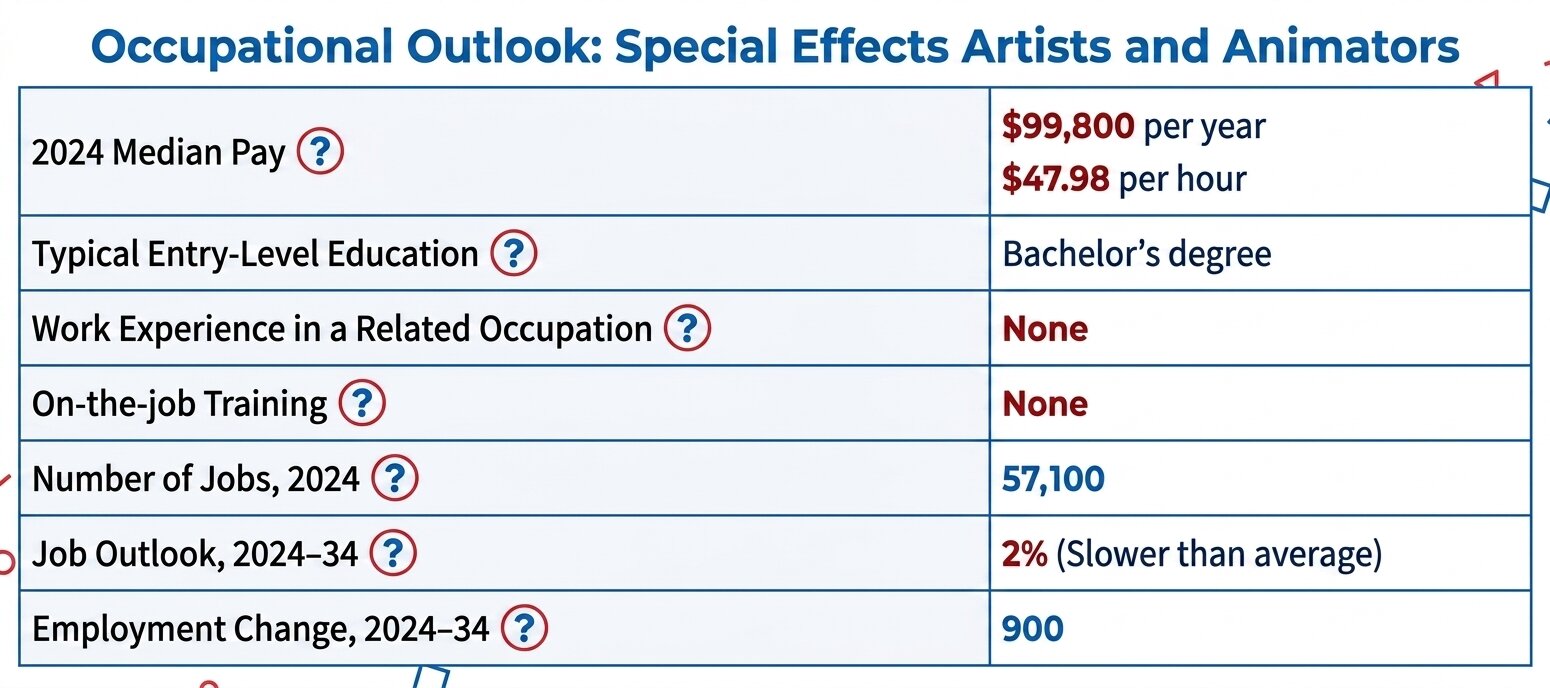
📌 Special effects artists and animators Projected Employment, 2034: 58,000 — BLS, 2026
📌 Median annual wages for animators: $99,800 — Bureau of Labor Statistics, 2024
📌 Animation industry job growth forecast: 2% from 2024 to 2034 — Bureau of Labor Statistics, 2026
The Drawbacks: Cost, Debt, and Outdated Methods
Top animation schools like CalArts and the School of Visual Arts (SVA) can cost upwards of $60,000–$80,000 per year in tuition alone. Beyond cost, some programs teach rigid stylistic approaches — such as a strict "Disney style" — that limit creative development. Animation software and industry trends also evolve faster than most formal curricula can keep up with. (Source: Research.com, 2026 Online vs On-Campus Animation Degree Programs)
- Debt that follows you — top schools like CalArts or SVA are often overpriced for what you get; $200K+ in student loans is a real number
- Rigid curricula — some programs push one style (looking at you, forced Disney style) and penalize students who go their own way
- Outdated methods — the industry moves fast; many schools are still teaching workflows that studios stopped using years ago
- Rapid software evolution — by the time you graduate, the industry-standard software may have completely changed
The International Factor: When a Degree Is Mandatory
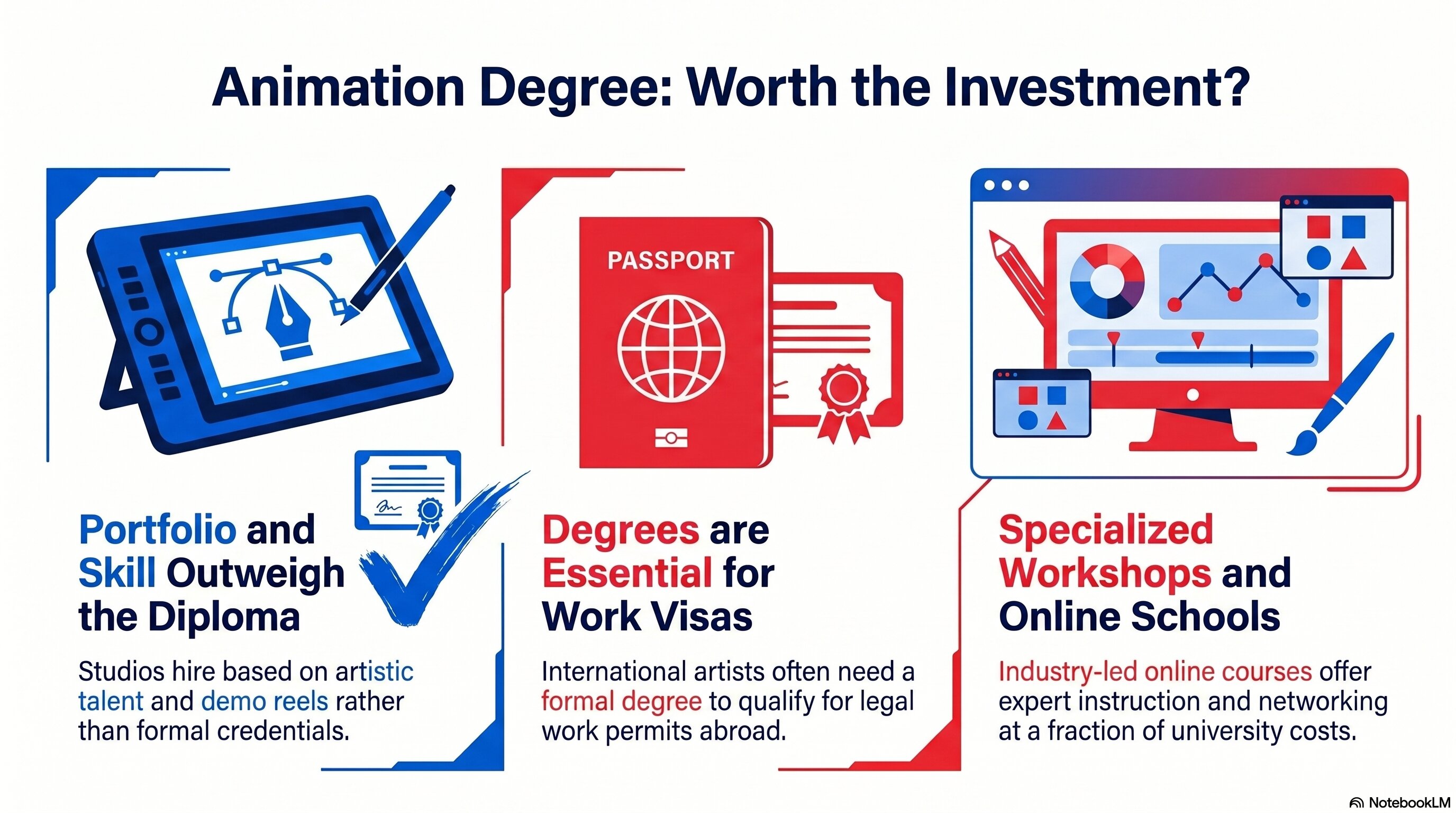
For international artists seeking employment in the United States or other countries, a degree is often a legal requirement for a standard work visa. Without one, obtaining an H-1B or equivalent visa sponsorship from a studio can be extremely difficult, regardless of skill level. In these cases, a degree functions less as an educational credential and more as a legal entry point. (Source: USCIS H-1B Specialty Occupations, 2026)
This is the one situation where the degree isn't optional. If you're not a citizen of the country where you want to work, a degree might be your legal ticket in.
When a degree becomes non-negotiable:
- Work visas — a degree is often required for a standard work visa if you're a foreign national wanting to work in the US or other markets
- Teaching roles — many academic institutions require a degree to hire faculty, even for adjunct positions
- Global prestige markets — in some countries and studios, a degree remains a "certification of excellence" that opens doors that nothing else will
Top Alternatives to a Traditional Animation Degree
Several alternatives to a traditional animation degree offer targeted, industry-relevant training at a fraction of the cost. Specialized online workshops from platforms like iAnimate and CGMA are taught by working professionals from major studios. Self-directed learning through YouTube, Discord communities, and independent film production have also produced professional-level animators without formal degrees. (Source: iAnimate Online Animation School, 2026)
The good news? You have more options now than any generation before you.
Alternatives worth considering:
- Specialized online workshops — best for focused skill-building. Platforms like iAnimate teach you exactly what studios want to see. Classes are run by working pros, not academics. You're learning current workflows, not textbook theory.
- Mentorships and shadowing — best for accelerated growth. Take the money you'd spend on tuition and invest it in a personal mentor or shadowing experience. One year with the right person can beat four years in a classroom.
- Self-directed learning — best for self-motivated learners. YouTube, community Discord servers, and free tutorials have never been better. The catch: you need a ruthless work ethic and accountability without a classroom structure forcing you.
- Independent film production — best for portfolio-building, fast. Use your "tuition money" as a film budget instead. Produce a short. Enter festivals. Some animators have launched full careers this way.
Key Factors to Consider Before You Decide
Step 1: What are your career goals? Does your dream studio require a degree — usually for visa reasons — or just a strong reel? Research the actual hiring requirements of 3–5 studios you want to work at before deciding.
Step 2: What's your learning style? Do you need the accountability of a classroom and peers? Or are you self-motivated enough to push through an online course alone? Be honest. Neither answer is wrong.
Step 3: What's your financial situation? Run the real numbers. Compare the total cost of a 4-year degree (tuition + living) vs. 2 years of targeted online workshops. Then calculate the ROI of each path based on average animator salaries.
Step 4: Do you need a work visa? If yes — and you're not a citizen of your target country — a degree may be mandatory regardless of everything else above. Talk to an immigration attorney before assuming.
"iAnimate has helped students from all over the world to navigate this exact decision. The visa question alone has changed the answer for hundreds of aspiring animators."
"I gained hands-on experience with industry-standard animation workflows and received direct feedback from top professionals.”
Verdict: Is an Animation Degree Worth It?
An animation degree is worth it in specific circumstances: when a work visa requires it, when structured immersion is the right fit for the learner, or when elite networking access is the primary goal. It is generally not worth it for students who will take on significant debt without a visa need, or for those with high self-motivation who can build a portfolio through workshops and independent work. The portfolio remains the definitive hiring factor in the animation industry.
It's worth it when:
- You need a work visa to work in your target country
- You thrive in structured environments with peer accountability
- You want elite networking access and are choosing a top-tier program
- You're using it as 3–5 years of funded immersion with zero financial pressure
It's probably not worth it when:
- You're a local student taking on heavy debt without a visa requirement
- You're self-motivated and can build a strong reel through focused workshops
- The program teaches outdated methods or forces a single style
- You just want to animate — and can get there faster another way
Bottom line: The reel is king. Build the best reel you can, by any path that gets you there.
Frequently Asked Questions: Is an Animation Degree Worth It?
Q: Do you need a degree to become an animator?
A: No. Most animation studios hire based on your demo reel and practical skills, not your degree. Many working animators at major studios like Pixar and DreamWorks have no formal animation degree. What gets you hired is a strong portfolio that shows you can do the work.
Q: Is an animation degree worth the cost?
A: It depends on your situation. If you need a work visa or thrive in structured environments, it can be worth it. If you're a local student taking on significant debt without a visa requirement, the ROI is often better through targeted online workshops or mentorships.
Q: What animation schools are worth going to?
A: CalArts, Sheridan College, and Ringling College of Art and Design are consistently ranked among the best for animation. Online programs like iAnimate and CGMA offer industry-relevant training at a fraction of the cost, taught by working professionals from major studios.
Q: Can I get a job at Pixar or Disney without a degree?
A: Yes. Both studios hire based on portfolio and skills. However, if you're an international applicant, you may need a degree to qualify for a US work visa. For domestic applicants, a strong demo reel covering character animation, 2D/3D work, and visual development is the deciding factor.
Q: What is the best alternative to an animation degree?
A: Specialized online workshops like iAnimate are the most targeted alternative. Taught by current industry professionals, covers industry-standard software, and costs significantly less than a 4-year degree. Pairing workshops with a personal mentor or self-directed portfolio projects can accelerate your progress further.
Q: How long does it take to become an animator without a degree?
A: Most self-taught animators or online workshop students build a professional-level demo reel in 2–4 years with consistent, focused practice. The timeline depends heavily on the quality of your training, the feedback you receive, and how much time you put in each week.
Written by Richard Arroyo
Richard Arroyo is Content Director at Ubisoft Montreal and Partner & Manager at iAnimate. With a career spanning feature film, animation, video games, and television since 1999, he has directed on major titles including Skull & Bones, Watch Dogs Legion, and Rainbow Six Siege. As one of the key figures behind iAnimate's game animation, rigging, motion capture, and creature programs since 2011, he has helped shape the next generation of professional animators worldwide. View Richard's profile at iAnimate.
📌 Key Takeaway: An animation degree is not required to work in the industry. Studios hire based on demo reel and skill. Whether a degree is worth it comes down to four factors: visa requirements, learning style, financial situation, and career goals.
Ready to Make the Call?
You now have the full picture. A degree can be a powerful tool — but it's not the only one.
The animators getting hired aren't the ones with the fanciest diplomas. They're the ones with the strongest reels.
Figure out which path builds yours fastest. Then commit to it completely.